
Get Happy
1954: The Sheik remembers a suspect as he chases him down


My knuckles were beginning to hurt from knocking on the splintery wooden frames of all those screen doors. My knees were beginning to hurt from climbing all those short steps to creaky lanais. My pride was already hurt because I was too slow to get the drop on him.
Happy Tokuda had vanished into thin air. Again. On an island. Who the hell does that? Maybe it shouldn’t surprise me. Happy had a hundred friends and just as many people who weren’t friends but who owed him favors. Often, he used what many a Hongwanji-volunteer matron referred to as his “natural charm”; they all swooned over his “rugged” good looks. I thought he just looked like the mechanics at my folks’ shop, only with a little extra pomade in his hair and better teeth. And then there were those he could dupe. There were lots of those. More than I could count.
Happy was Chaucer’s miller, the perpetual vagabond who dared to match his betters and somehow managed to upstage them. It’s true that many found Happy and his ways offensive at a distance, but they had to look his way with rapt attention despite their disgust and contempt, and that is where he managed to fleece them. Not me. I never fell for it. I first met Harry “Happy” Tokuda when I was in my junior year at McKinley High School. McKinley was a big block just Diamond Head of downtown Honolulu; it was bordered by King Street on its mauka side and Kapiolani Boulevard on its makai side. It was hemmed in by lands belonging to the Victoria Ward Estate and Pensacola Street. McKinley’s location made it convenient to both Kakaako and Sheridan Tract, neighborhoods crammed with Japanese families and businesses, which earned it the moniker of “Tokyo High.” My four older sisters preceded me in attendance there.
I had earned a starting spot on the varsity baseball team as a first baseman, probably owing to my size. At just a fraction of an inch shy of six feet, I was big for a Japanese boy. Even the Hawaiian kids on Kamehameha’s team who played outfield backed up when I approached the plate. I always got a kick out of that.
Happy Tokuda was in his late twenties at the time, a man with enough time on his hands to drop in on a high school baseball practice when most grown men had things in their lives that robbed them of time, like jobs. Happy wasn’t burdened that way. He was what the obasans called “chanbara handsome,” like the one samurai movie protagonist that had a wild mane of long, tousled hair instead of a shaved pate. He walked with B-movie swagger, like a poor man’s John Wayne in chaps. He dressed like the foppish, low-rent confidence man that he was, a silly little black wool beret tilted at a rakish angle on his pomade-slicked head, the kind I had seen painters and schoolgirls wear when I was in France during the war. His lean frame was dressed up with a checkered sports coat and a bright shirt with no tie, baggy trousers, and saddle shoes.
And Happy smiled. A lot. I think it was probably his normal expression. The idiotic grin was a natural feature. Almost everyone who met Happy thought his smile was what gave him his name, but it was really his poor penmanship that was responsible. When he signed his name, Harry, his r’s looked like p’s thanks to the fact that he mixed uppercase and lowercase letters in his printed signature, like a slow child.
Happy dropped by our practice to sell bubble gum and chewing tobacco and occasionally much more wicked contraband like cigarettes and girlie magazines, and all at dirt cheap prices. He carried his wares in a worn leather briefcase, like he was some kind of businessman headed to the boardroom. We all gave Happy many of our nickels for something to stick in our mouths during batting practice. Guys without fathers who kept liquor in the house or without the guts to pilfer it often put clandestine orders for hooch in with Happy, who would obtain a pint of bourbon or bottles of beer and deliver the goods at the gate behind centerfield on Queen Kapiolani Boulevard after practice.
I went on patronizing Happy’s portable store like everyone else for a couple of weeks until I learned that his goods were shoplifted from a few nearby mom-and-pop stores. Wally Yoshida and Sam Nomura were talking about it during batting practice. They muttered under their breath about overhearing the owners of the Wong Market talking to the police about the Japanese man with the funny hat and how a lot of their merchandise had gone missing. Wally was so goody-goody and gullible he even mused aloud that the shop owners had to be mistaken. I knew better: the smarmy son-of-a-bitch couldn’t have obtained his cheap goods any other way.
When I found out that my hard-earned nickels were being spent on stolen goods, I was livid. I told Happy so. If there was one thing I could never tolerate, it was people who thought they could leapfrog others by breaking the rules. Kids who cut in line to get the last of the penny candy. Adults who called in favors to get a better seat, better view, better deal than the masses who had no such favors to call in. They thought they were better. They weren’t. They were just cheaters. Few things gave me more satisfaction than putting them where they belonged, whether it was at the back of the line, behind bars, or under my self-righteous foot.
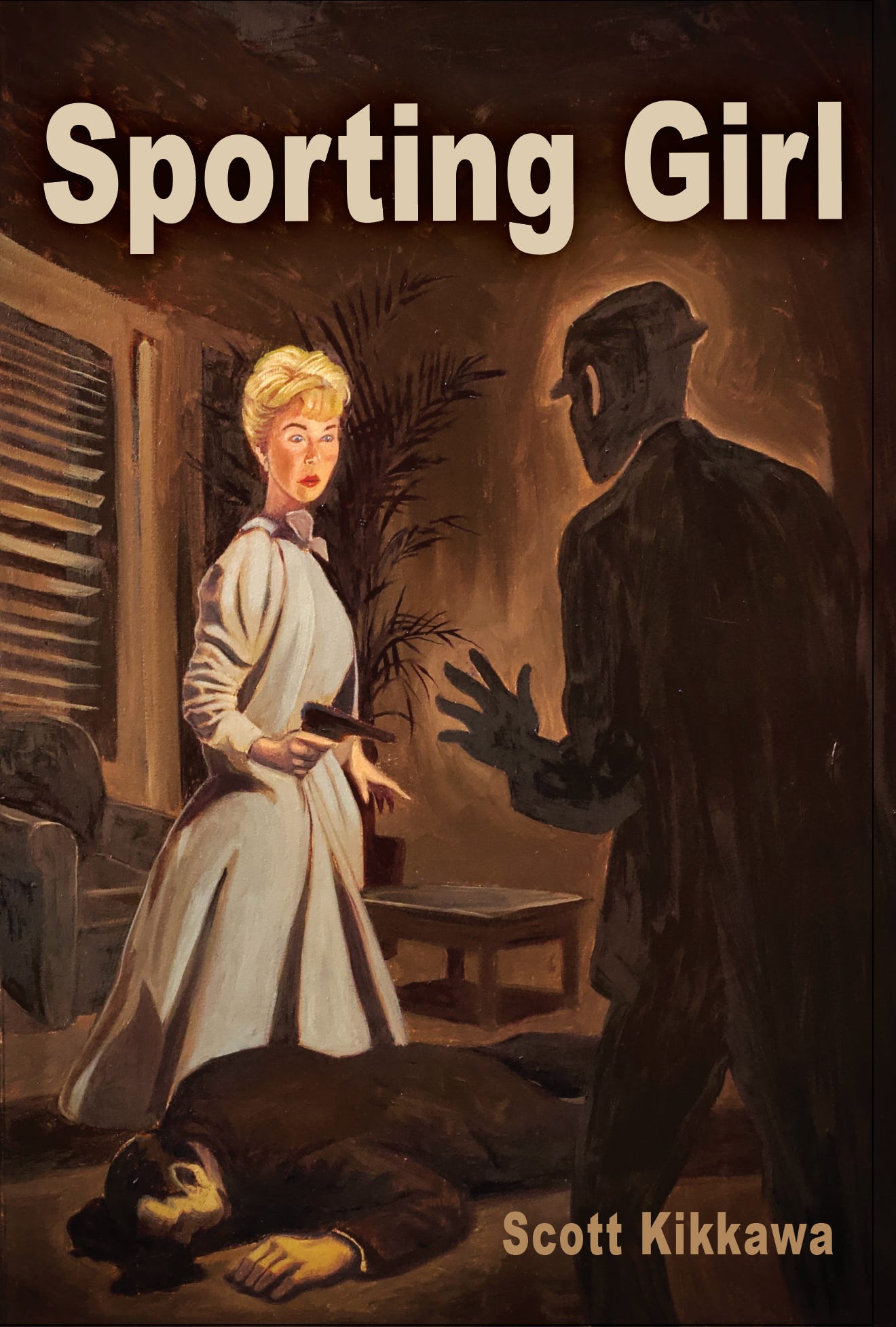
This was an excerpt from my fourth novel, Sporting Girl (Bamboo Ridge Press, 2026).
Hello scott, I'm the student from the may 8th talking event at housei. I've been trying to reach out to you via email but it seems it's not getting though. I've been wanting to show you about Yoshiko Shinkura, the 1950s jazz singer. It would be great if we could get connected.
Looking forward to SPORTING GIRL. No news yet at the websites for Bamboo Ridge or da Shop.
I hope Happy[ness] won't disappear before the end of the month... and that your book will have happy knuckles, happy spines, happy minds... as we settle in to the next book.
Have a good summer! Happy writing, reading, and exploring.